
Indy's Least Wanted
Invasive Plants of Marion County - Japanese Honeysuckle

I was at Garfield Park at the Earth Fest 2026; put on by Earth Day Indiana. I stopped by the booth Indiana Native Plant Society because I was curious to learn more about what I could do in my yard to help Hoosier plants and animals.
The booth was poppin’, it was good to see.
People were helping themselves to all kinds of information set out on the table. It seemed like a good idea to join in the fray and try to gain some of that treasure for myself.
That was a correct assumption. I then found myself in a conversation with two workers who indicated that they needed volunteers to bolster a program in Marion County which already had robust support in neighboring Hamilton (and possibly Boone) County.
Unfortunately, my neurodivergence has yet again robbed me of some minor details of the encounter. Knowing my brain, I hit that table for pamphlets and handouts like a cheap buffet.
If you’d like more information on how to get involved, all resourced will be linked at the end of this article.
In order to draw attention to their cause, I figured I would do what I do okay sometimes and make some educational content on invasive species!
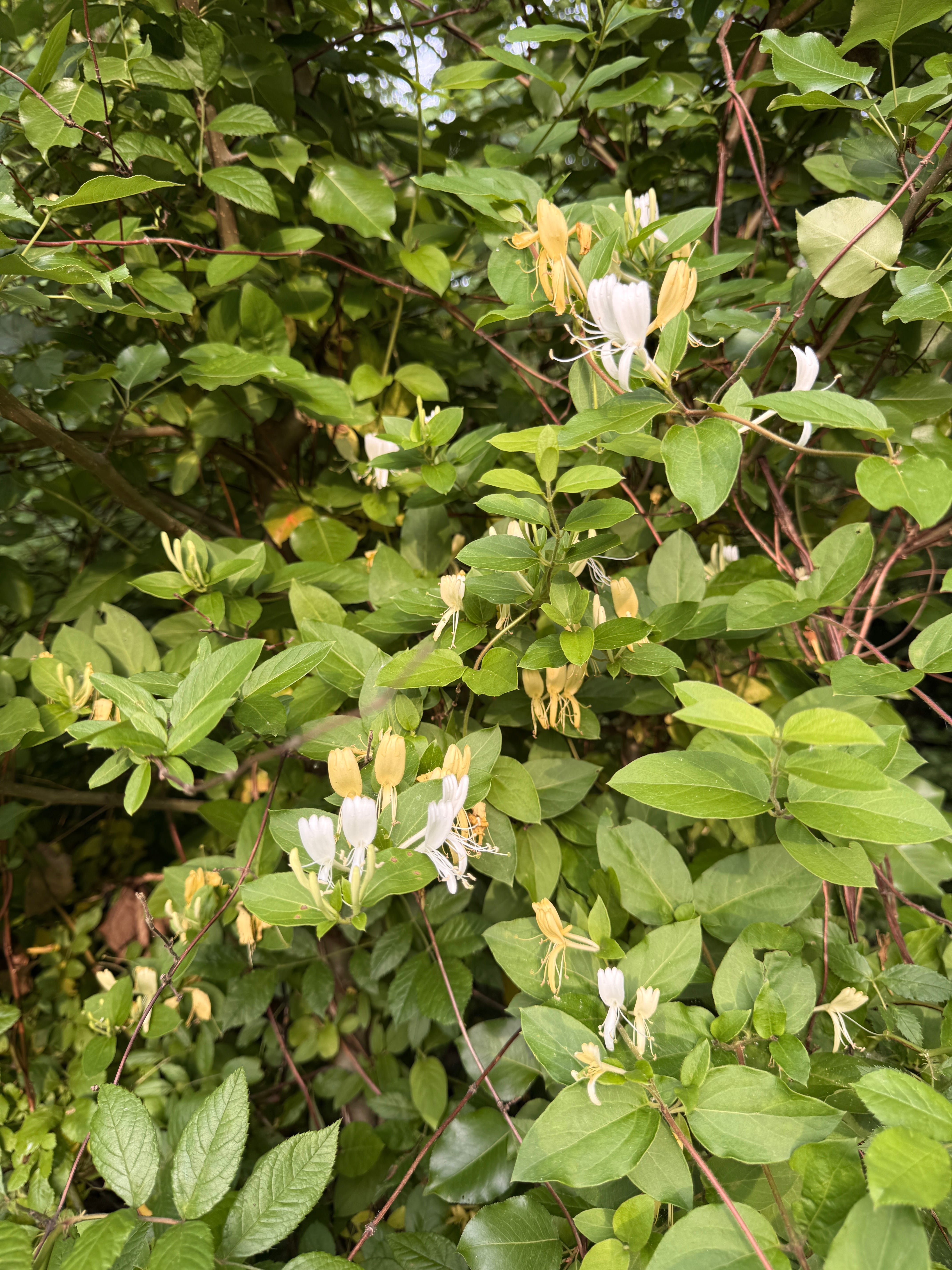
Image by Daniel Z Figac, author of this article.
Honeysuckle Phonies
To be honest, I first heard this term in a song by Panic! At the Disco; and while I could not find a definitive source for the idiom, I thought it was fitting since there actually are native, non-invasive varieties of honeysuckle. I want to start this article with of varieties to avoid, according to almanac.org
“In some regions of North America, invasive honeysuckles have become a considerable problem. They can choke out native trees and cover large patches of land with nearly impenetrable ground cover. Their spread is aided by the birds that feast on the fruit and then drop the seeds in new locations.
To avoid unintentionally causing an infestation, avoid planting these commonly available species:
Japanese honeysuckle – Lonicera japonica
Morrow’s honeysuckle – L. morrowii
Amur honeysuckle – L. maackii
Bell’s honeysuckle – L. x bella
Several other Lonicera sp. are also considered invasive based on your location. Search online for “Lonicera + invasive species + your state’s name.”"
For Indiana, I spared you the hassle: Indiana’s Bad Guys
Identification
It is important to be equipped with the knowledge to differentiate between the two species so that you can do what you can on your own private property, like avoiding it at the nursery, or eradicating it in your landscaping or wooded areas.
Here is what I gathered from a site called Week&, a subsidiary of Hearst Communications:
“
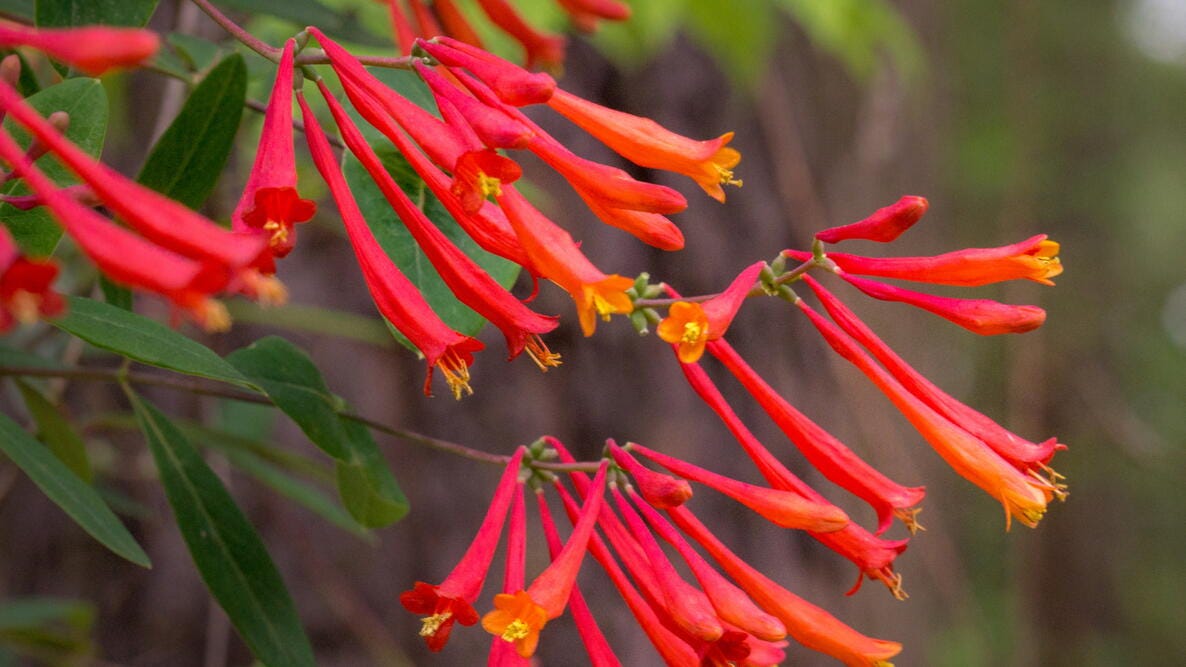
Coral honeysuckle (Lonicera sempervirens)
Image Credit:
Charles Collard/Shutterstock
Honeysuckle Identification: Leaves
Trumpet honeysuckle is hardy in U.S. Department of Agriculture plant hardiness zones 4 through 9, and Japanese honeysuckle is hardy in zones 4 through 10, so your local climate does little to help differentiate. In mild-winter areas both plants are evergreen, and at a quick glance the leaves of Japanese and American honeysuckle appear similar. Both have compound leaves with oval-shaped leaflets ranging from 1 to 3 inches long.
A closer look reveals a slight difference in their leaf color. Japanese honeysuckle leaves are deep green on the top and underside, but American honeysuckle leaves have a medium-green upper surface and a bluish-green underside. Some Japanese honeysuckle varieties have variegated leaves, which is a less subjective indicator.
Honeysuckle Identification: Flowers
Once in bloom, the difference between Japanese and trumpet honeysuckles becomes clear. Trumpet (American) honeysuckle has 1- to 2-inch-long, tubular-shaped flowers. The flowers are pinkish-red on the outside and orange to yellow inside the tubes.
Japanese honeysuckle’s flowers do not form a complete tube. Instead, the petals flare into two lips. This flare reveals the stamens, giving a frilly appearance to the flowers, which are often white with tinges of either yellow, purple or pink, depending on the variety. Depending on your eyesight you may need a magnifier to see the difference, but it’s a clear differentiator.
Honeysuckle Identification: Fruit
After they bloom, honeysuckles produce round berries that provide a source of food for birds and other garden creatures. These berries are another clue to help you identify your honeysuckle. Japanese honeysuckles produce black berries, but the berries of trumpet honeysuckle are red and slightly smaller than Japanese honeysuckle’s fruit. This is a conclusive way to tell the difference, if you’re still uncertain after looking at the leaves and blossoms.
Honeysuckle Identification: Blossoming Season
Although they both put on a floral show, Japanese and trumpet honeysuckles bloom at slightly different times. This timing can help you identify which plant you have. Trumpet honeysuckle has a short bloom period, from May to June. Japanese honeysuckle blooms throughout summer and into fall, from June to October.
References
The New Sunset Western Garden Book; Kathleen Norris Brenzel, Editor
U.S. Department of Agriculture: Plants Profile for Lonicera Japonica (Japanese Honeysuckle)
November 12, 2013|Updated June 22, 2020 6:02 p.m.”
This invasive plant was easy to start with because, well, it is everywhere. We need some serious help to get this one under control.
References, etc.:
My content is behind a temporary paywall. This lasts a week to give my supporters early access as a way to say, “thanks for making this type of independent research possible.” After that, this important information will be available to the general public. Thank you for your support. Here are the sources I used in this article.